Your premier HR partner
Let us take on your HR functions so you can strive for greatness.
Contact us.

Artificial intelligence (AI) is quickly becoming part of everyday work. From drafting emails to analyzing data, AI can help employees work faster and more efficiently. However, adopting AI isn't just about choosing the right tools, it's also about setting expectations, protecting company information and giving employees clear guidelines for how AI should be used in their workplace.
The organizations seeing the most success with AI are balancing technology with thoughtful policies and training.
AI can automate many routine tasks that consume valuable time throughout the day. Things like drafting emails, organizing information, summarizing meetings and generating reports can often be completed more quickly with AI support.
It can also help employees tackle tasks outside their natural strengths. For example, someone who struggles to analyze large amounts of data can use AI to identify trends, compare information and find insights more efficiently.
In many cases, AI acts as a sounding board, helping employees think through challenges, organize ideas and evaluate different approaches before making decisions.
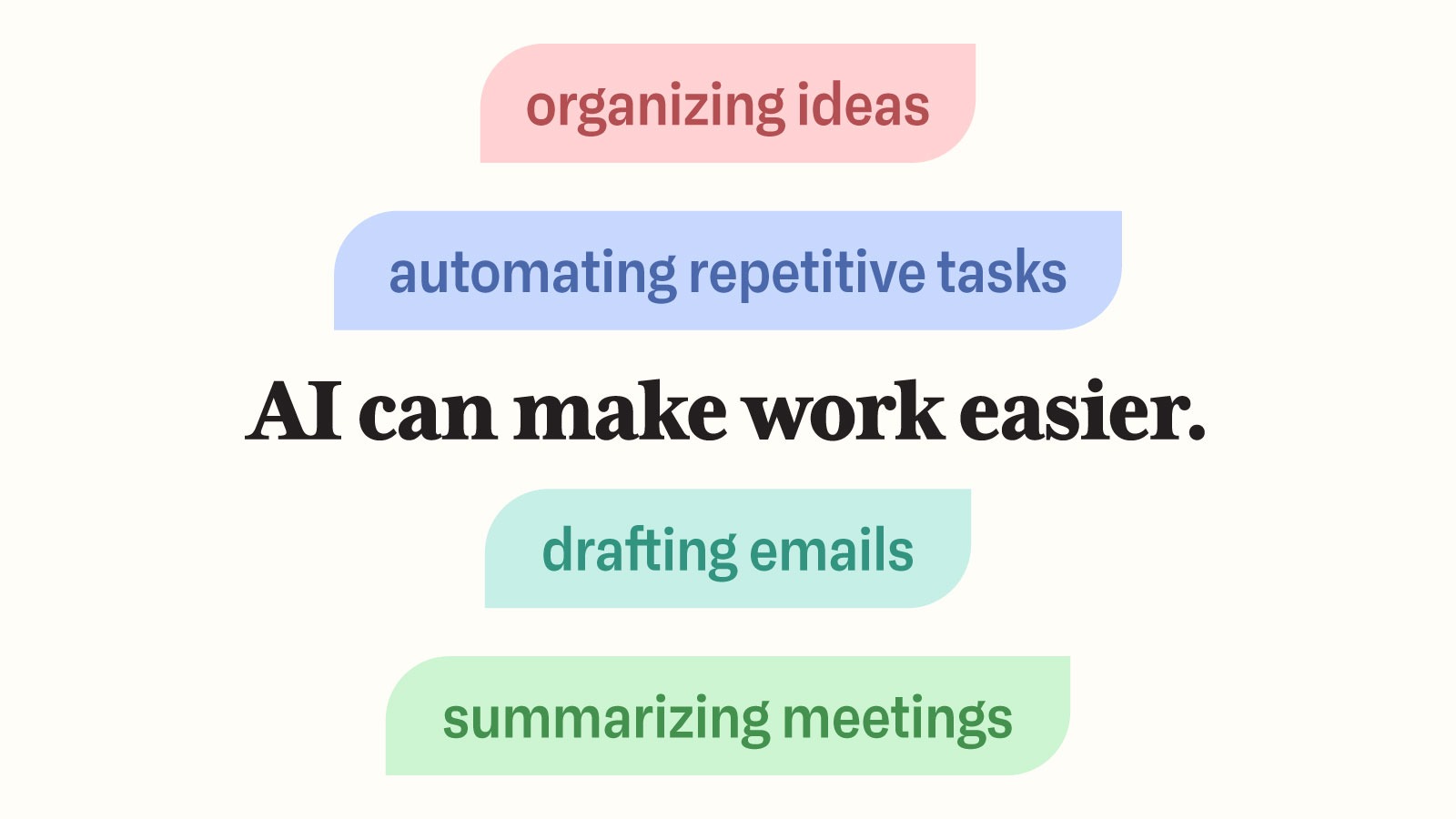
One of the biggest benefits of AI is that it helps reduce time spent on repetitive tasks.
Instead of manually sorting through data, prioritizing tasks or compiling information from lengthy email threads, employees can use AI to handle much of the administrative work. That allows them to focus on higher-value responsibilities that require critical thinking, problem-solving and relationship building.
For small and midsize businesses, this can help create capabilities that previously required specialized expertise or additional staff.
While AI can be a powerful tool, it's not perfect.
AI-generated content should always be reviewed by a person before decisions are made or information is shared. AI can make mistakes, misinterpret information or generate incomplete responses. Human oversight remains essential to ensure accuracy, context and sound decision-making.
AI should support employees, not replace their judgment.
As more employees use AI tools, businesses must understand the potential risks.
One of the biggest concerns is data security. Public AI platforms may use submitted information to improve their models or process future requests. If employees enter confidential business information, client data or personally identifiable information (PII) into unsecured AI tools, that information could be exposed in ways the company did not intend.
This is why organizations need to give their employees clear guidance around what information can and cannot be entered into AI systems.
Even companies that are not actively encouraging AI use should have an AI policy.
The reality is that employees may already be using AI tools on their own, and a policy helps establish expectations before issues arise and provides clarity around acceptable use.
For organizations that do encourage AI, a policy creates consistency across the workforce. It allows leadership to define approved tools, establish review processes and ensure employees are using AI responsibly.
At a minimum, an AI policy should address:
Companies should also consider personal AI tools, including generative AI applications, smart devices and other technology that may capture or process company information.
An AI policy is only effective if employees understand it.
Before employees begin using AI tools, they should understand how the technology works, the risks involved and their responsibility as the end user. Training helps employees make informed decisions and reduces the likelihood of misuse.
As AI technology continues to evolve, organizations should review their policies annually at a minimum and provide additional training whenever significant changes occur.
AI is moving quickly, and many employers are still determining what role it should play within their organizations.
Syndeo can help businesses develop an AI policy that aligns with their goals, risk tolerance and workplace culture. We can also assist with updating employee handbooks, providing employee training and helping leaders establish clear guidelines around AI use.
The goal isn't to avoid AI. It's to use it responsibly.
When paired with the right policies, training and oversight, AI can be a valuable tool that helps organizations improve efficiency while protecting their people, data and business.


Let us take on your HR functions so you can strive for greatness.
Contact us.
